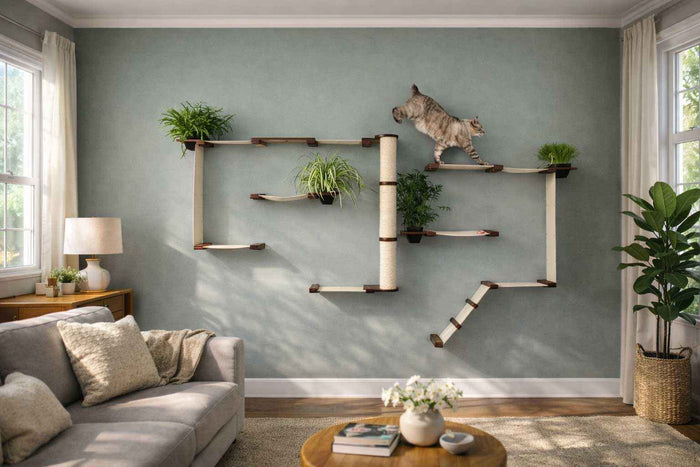
A cat climbing wall is a commitment rather than an impulse purchase, and the owners who are happiest with the result are the ones who thought through the planning phase carefully before drilling the first hole. The planning determines everything: which wall to use, what configuration to install, which elements to include, how to make the system navigable as a climbing route rather than a collection of random wall-mounted objects.
The planning phase is also where the aesthetic integration happens. A climbing wall designed in advance, with attention to spacing, material choices, and relationship to the room's existing design language, ends up looking like it was always part of the room. One that's assembled incrementally without a clear plan can look interesting to the cat but visually chaotic to everyone else. Starting with a clear vision of the end result makes the building process more focused and the finished result more satisfying.
Which Wall Should a Cat Climbing Wall Go On?
The best wall is one that's visible from the main seating area, near a window if possible, and has a clear vertical run without major interruptions from doors, windows, switches, or outlets at inconvenient positions. Visibility matters because cats use climbing walls more when they can do so while remaining in the social space of the home rather than retreating to a secondary location.
Studs are the practical structural constraint. Mark their positions before finalizing your configuration, because the most reliable mounting positions are into studs rather than into drywall alone. If the configuration you want doesn't align with stud positions, use appropriately rated hollow-wall anchors, but confirm the load rating against the combined weight of each shelf and the expected maximum cat weight before proceeding.
Cat climbing wall elements at TheMeowPicks include shelves and platforms from independent makers who provide appropriate installation hardware and clear mounting guidance. The platform sources these pieces with long-term safety and reliability as part of the evaluation criteria, because a climbing wall that fails is a safety risk as well as a property damage issue.
What Is the Most Effective Climbing Wall Configuration?
The answer depends on the wall's dimensions and the cat's characteristics, but some structural principles apply broadly. An entry point accessible from the floor or from existing furniture at eighteen to twenty-four inches above floor level gives the cat a natural starting position without requiring an athletic leap. From there, platforms spaced fourteen to eighteen inches apart vertically create comfortable jumping intervals for most adult cats.
At the top of the system, a destination platform of generous size, at least fourteen inches deep and preferably wider, gives the cat somewhere to settle and observe from the highest available point. This destination is the most used element in most climbing wall systems, and its size and comfort determine how much time the cat actually spends at height.
Including at least one enclosed element, a box shelf or cat cave at mid-height, provides sheltered resting space that open platforms can't offer. Cats use enclosed spaces for deeper sleep and for retreat when they want privacy, so having this option at height gives the climbing wall more functional variety.
How Do You Keep a Cat Climbing Wall Looking Good Over Time?
Regular inspection is the maintenance habit that matters most. Check the anchor points of heavily used shelves monthly for any sign of movement or loosening. A shelf that's started to drift from perfectly level or that shows any movement when firmly pressed should be re-secured immediately rather than monitored to see if it gets worse.
Platform surfaces need regular vacuuming and periodic more thorough cleaning. Platforms at the highest levels accumulate the most use because they're the prime territory, and they show wear first. Replaceable surface inserts on these elements make the practical maintenance considerably simpler. Sisal surfaces, whether on post-style elements or on scratch-pad inserts, eventually wear to the point where they need replacement rather than maintenance.
Modern cat tree pieces that connect a climbing wall to the floor level often need less maintenance than the wall elements because they're replaceable without wall repair. TheMeowPicks curates both freestanding and wall-mounted options as complementary parts of a complete cat environment, and the platform's standards apply equally to both. A portion of every order goes to cat rescue, connecting each purchase to something beyond the individual home.
Conclusion
A well-planned and properly installed cat climbing wall is one of the most enriching and visually interesting things a cat owner can do for an indoor cat. The planning investment pays back in a system that's actually used enthusiastically, looks intentional in the room, and provides years of daily climbing and territorial enrichment without occupying a single square foot of floor space. Plan carefully, install properly, and the result is worth every step of the process.
FAQ
Q: How much does a complete cat climbing wall system typically cost?
A: A quality four-to-six shelf system from a design-focused maker typically runs from two hundred to six hundred dollars depending on the materials, the complexity of elements, and the maker. Installation hardware adds minimal cost.
Q: Can a cat climbing wall work with an existing cat tree?
A: Absolutely. A climbing wall can connect to a cat tree as its base entry element, extending the vertical territory from the freestanding structure up the wall. This hybrid approach is particularly effective in rooms where a floor anchor point and vertical wall space both exist.
Q: How do I know if my cat will use a climbing wall once it's installed?
A: Cats that already seek the highest available points in the home, that climb bookshelves or sit on top of cabinets, are strong candidates for climbing wall enthusiasts. Cats that prefer lower perches may use the intermediate levels without ever reaching the top, which is still enrichment.